
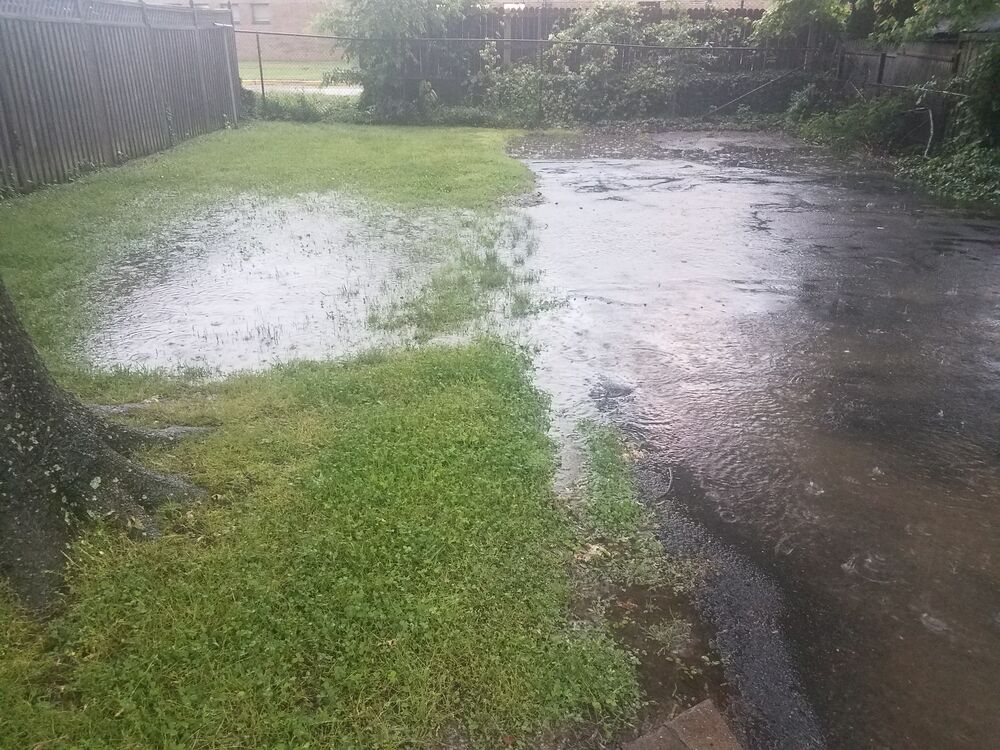
A good soaking rain rolls through Noblesville, the sun comes back out, and two days later your backyard still looks like a pond. Sound familiar? Around Indy, it’s practically a spring tradition. A little water after a storm is normal. Water that won’t leave, or that keeps creeping toward your house, is your yard telling you something.
The Swain family has been looking at wet yards, soggy foundations, and the basements and crawl spaces underneath them since the early 1980s. This guide walks through the most common signs that your exterior drainage isn’t doing its job, what’s usually behind them, and the fixes that actually move water where it belongs.
Central Indiana is pretty flat, and like much of the region, the soil around Noblesville tends to have a lot of clay in it. Clay soil doesn’t absorb water quickly, so during a heavy rain the water sits on top or runs off wherever the yard tilts. If the yard tilts toward your house, that’s where it ends up.
Flat lots, clay soil, and downspouts that empty right next to the foundation make a tough combination. Water collects around the house, soaks the soil against your foundation walls, and seeps into basements and crawl spaces through block seepage and cracks. Good exterior drainage gives that water somewhere better to go.

Your yard and your house drop plenty of hints when water isn’t draining the way it should. Grab your boots after the next storm and take a walk around. Watch for these.
A few puddles right after a downpour are no big deal. Lingering puddles are a different story. When there’s standing water in yard low spots two or three days after a storm, it usually means the ground can’t absorb the water fast enough and there’s no path for it to drain away. Over time, it kills grass, turns the lawn into mud, and, if it sticks around for a week or more, provides mosquitoes a breeding ground.
This one deserves your attention. When water collects against your house, it soaks the soil around your foundation walls and builds pressure against them. That water eventually looks for a way in, and porous block, joints, and small cracks make it easy.
You can check this yourself. Stand at the foundation and look at how the ground runs for the first 10 feet out. The International Residential Code, a model building code rather than a local Noblesville rule, calls for the soil to drop about 6 inches over that distance. If the ground is flat, or tilts back toward the house, water will collect there every time it rains.
Hairline cracks in poured concrete are common, and plenty of them come from normal shrinkage as the concrete cured. Pay closer attention to cracks that widen over time, let water through, or run horizontally along a block wall. Stair-step cracks through the mortar joints are another red flag. Wet clay soil swells and dry clay shrinks, and on a block wall that pressure can push the wall inward until it starts to bow. If the cracks are getting bigger or the wall looks out of line, the water problem outside may be turning into a foundation repair problem.
Your nose often catches this before your eyes do. A musty smell downstairs, damp spots on the walls, peeling paint, or white, chalky residue (efflorescence) on the block all indicate moisture seeping through the foundation. Mold and mildew love those conditions, and the air from your basement circulates through the rest of your home.
Crawl spaces get hit hard by bad drainage. Water that pools outside seeps through the foundation block or pushes up through the dirt floor, leaving standing water, soggy insulation, and damp wood. Being left alone leads to wood rot, mold, and sagging floors. If your crawl space looks wet every spring, the yard may be part of the reason.
Runoff that moves across your yard in the wrong direction takes soil with it. Watch for little channels cut into the lawn, bare patches where grass won’t grow, mulch that ends up on the sidewalk, or dips that weren’t there a few years ago. Those are signs that water is moving fast across the surface instead of soaking in or draining away.
Take a look at where your downspouts end. A lot of them stop a foot or two from the foundation, or empty onto a splash block that’s sunk into the dirt. Here’s why that matters: One inch of rain on 1,000 square feet of roof adds up to roughly 620 gallons of water, and every drop leaves through your downspouts. When they empty next to the foundation, most of that water soaks right back into the soil against your walls.
Water that pools on or along your driveway can undermine the base underneath, crack the surface, and wash out the edges. If the driveway slopes toward your garage or house, that water can end up right where you don’t want it.
No two yards drain the same way, so there’s no one-size-fits-all fix. The right answer depends on where the water comes from, where it collects, and where it can safely go.
Every drainage job starts with a walk around the property. Our inspectors look at the layout of your yard, how the lot slopes, where downspouts empty, and where water collects after a storm. We can also take laser site measurements to get an accurate read on the grades and slopes, since a yard that looks flat can still tip toward your house by just enough to cause trouble. From there, we design a yard drainage plan for your specific property. We’ve handled exterior drainage on everything from single-family homes to commercial properties, including more than 300 linear feet of exterior foundation waterproofing and drainage at New Hope Church in Greenwood.
Use this as a starting point for the conversation with whoever inspects your property. The right answer still depends on what’s happening at your house.
| What You’re Seeing | Common Cause | Fix to Ask About |
|---|---|---|
| Erosion channels or washed-out mulch | Fast runoff from the roof or a slope | Downspout extensions, yard drainage |
| Puddles on or along the driveway | Driveway sloping toward the house or garage | Driveway drainage |
| Standing water in low spots for days | Clay soil and a low spot with nowhere to drain | French drain, yard drainage system |
| Water pooling at the foundation | Short downspouts, ground sloping toward the house | Below-grade downspout extensions, French drain |
| Wet basement or crawl space after outside fixes | Groundwater or block seepage | Basement or crawl space waterproofing |
A French drain is one of the most effective ways to handle both surface water and groundwater. French drain installation starts with digging a trench, lining it with gravel, and laying a perforated pipe inside. Water soaks into the gravel, enters the pipe, and flows to a safe discharge point, such as a drainage ditch or storm sewer.
A few details make or break a French drain. The pipe needs a steady downhill run to a discharge point lower than the problem area, which takes some planning on a flat Noblesville lot. French drains handle groundwater and surface runoff well, but if most of your water is coming off the roof, fixing the downspouts is usually the first step. Because the job involves trenching, we call Indiana 811 as needed to have underground utility lines marked before we dig.
For a lot of homes, this is the simplest and most budget-friendly fix on the list. We install our downspout extensions below grade, so you don’t have pipes lying across the lawn for the mower to catch. Each line runs far enough from the house that the water can’t make its way back toward your foundation. One customer who reviewed us said we wrapped up their downspout drain project in half a day.
Good downspout drainage helps protect your basement and crawl space from water problems, keeps soil from washing out around the house, and lowers the risk of foundation settling. Since it carries all that roof water away from the foundation, it’s often the first fix worth considering.
Some yards need more than one fix. A complete yard drainage system might combine French drains, below-grade downspout lines, and other drainage components, which we lay out based on your property’s measurements. The system drains low spots, carries roof water off, and lets the lawn dry out after a storm instead of staying soggy for days.
Pooling water is rough on driveways. When it seeps under the edges, it softens the base, and Indiana’s freeze-thaw cycles turn small cracks into big ones. Driveway drainage systems channel that water away so it doesn’t sit on the pavement or run toward your garage and foundation. The result is a driveway that holds up better and looks cleaner, which doesn’t hurt your curb appeal either.
Drainage problems rarely fix themselves. Every heavy rain sends more water toward the same weak spots, and the damage adds up quietly. Soil keeps washing out, foundation cracks keep widening, and moisture keeps seeping into the basement or crawl space.
Catching it early usually means a smaller, simpler fix. For a sense of scale, our 2026 pricing guide puts sagging floor and crawl space wood repair at $15,000–$22,000, bowing wall repair with wall anchors at $15,000–$20,000, and full perimeter basement waterproofing at $18,000–$25,000 or more. Those are the kinds of repairs years of bad drainage can lead to. Fixing the water outside is typically a much smaller project, which is why it pays to look at the outside of the house, even when the problem shows up as a wet basement.
Sometimes water has already found its way in. If you’ve got a leaky basement, standing water in your crawl space, or cracks that are letting water through, exterior drainage is still a big part of the solution, but it may not be the whole answer.
That’s where our other services come in. Basement waterproofing in Noblesville, IN can include interior drainage, a Zoeller sump pump with battery backup, and a 20-mil wall barrier that work together to keep water out of your living space. Crawl space waterproofing uses drainage systems, sump pumps, and vapor barriers to keep the space under your home dry. If the foundation has already started to move or crack, foundation repair may need to come first. We’ll tell you honestly which pieces your home needs, and which ones it doesn’t.
Look for puddles that last two or three days, water collecting near your foundation, soil that stays soggy, erosion channels in the lawn, and downspouts that empty right next to the house. Inside, musty smells, damp walls, and water in the crawl space are good clues too.
The usual suspects are clay soil that drains slowly, a yard that slopes toward the house, and downspouts that dump water too close to the foundation. Clogged gutters can make it worse by spilling water over the edge during a storm.
Some of it, yes. Start with the easy stuff. Clean out the gutters, make sure every downspout is connected, and check where each one empties. Then walk the yard during or right after a heavy rain and jot down where water runs and where it sits. Those notes are gold for whoever inspects your property. Bigger jobs like French drains and below-grade lines involve trenching, getting the slope right, and finding a proper discharge point, so that’s when it makes sense to call a pro.
Yes. Water that collects around the foundation soaks the soil, builds pressure against the walls, and works its way in through cracks and porous block. Fixing the drainage outside reduces the amount of water reaching the foundation. If the basement is already leaking, basement waterproofing in Noblesville, IN may be needed too.
It sure does. When water pools outside, it often ends up seeping into the crawl space or rising through the dirt floor, which leads to damp air, mold, and wood damage. Good exterior drainage paired with crawl space waterproofing is one of the most reliable ways to keep that space dry.
For many homes, they’re one of the most budget-friendly fixes out there. Below-grade downspout extensions move roof water well away from the foundation, which protects the basement or crawl space and helps prevent soil erosion and settling around the house.
If your yard turns into a swamp every time it rains, or water keeps showing up where it shouldn’t, don’t wait for it to get worse. The sooner you deal with drainage, the smaller the fix usually is.
Give us a call to set up a free estimate. We’re in the office Monday through Friday, 8 a.m. to 5 p.m. We’ll inspect your property, explain what we find, and recommend only what your home actually needs.
Business Name: SwainCo.
Address: 500 Polk St #28, Greenwood, IN 46143
Phone: 317-407-1868
Business Hours:
Mon - Fri: 8:00 AM to 5:00 PM
Sat-Sun: Closed