
Updated November 3, 2026, by Adam Swain, owner of SwainCo.
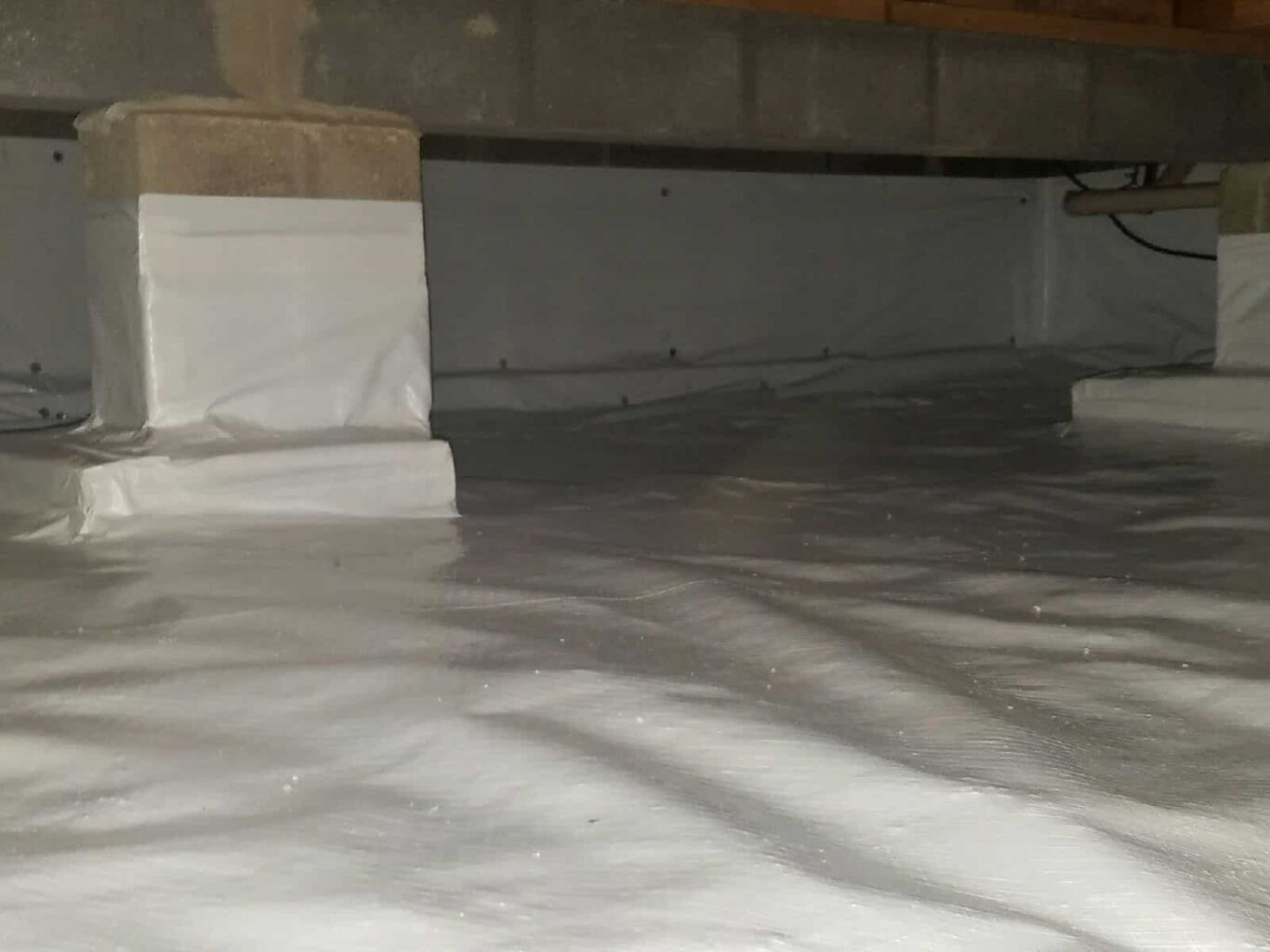
Picture two crawl spaces under two 1,200-square-foot homes. In the first, someone laid plastic over the dirt and stopped there. In the second, the liner is sealed wall-to-wall, and the vents are closed. The floor drains to a sump pit, and a dehumidifier keeps the air dry. Both are sold as encapsulation. Only the second is built for a wet Indiana spring.
That’s why two quotes for the same house can differ widely. We see it all over Central Indiana, where clay-heavy soil holds water close to foundations. Below, you’ll find our 2026 price ranges, the line items Indiana’s residential code expects, and how to read a quote so you’re comparing the same job.
Direct Answer
In the Indianapolis area, crawl space encapsulation typically costs $8,000 to $12,000 with SwainCo. A full encapsulation system with a drainage system, sump pump, and dehumidifier usually runs $15,000 to $20,000. Indiana’s code also expects the crawl space floor to drain to a sump pit or gravity drain, so ask how each quote handles drainage.
The sections below show what each price covers, what moves it, and what Indiana’s code expects.
TL;DR
- SwainCo.’s crawl space encapsulation typically runs $8,000 to $12,000, and a full system with drainage, a sump pump, and a dehumidifier usually runs $15,000 to $20,000.
- Size, clearance, existing condition, liner and wall coverage, water entry, dehumidifier sizing, and obstacles decide where a project lands.
- Indiana’s code expects the crawl space floor to drain to a sump pit or gravity drain, so ask how each quote handles drainage.
- Indiana replaced the national 70-pint dehumidifier option with a conditioned-air path, and its insulated-wall path adds a pad and outlet beside the sump or drain.
- Code sets the liner’s vapor rating and sealing, not its thickness.
- A per-square-foot rate only compares fairly when both quotes count the same square feet.
One-liner: Ask what every quote covers, line by line, and ask where the water goes if it gets under the liner.
Key Numbers
| Stat | What It Measures | Source |
|---|---|---|
| About $1,500 | Crawl space vapor barrier | SwainCo., 2026 |
| $2,000 to $3,000 | Sump pump with battery backup | SwainCo., 2026 |
| $4,000 to $12,000 | Crawl space mold remediation | SwainCo., 2026 |
| 18 by 24 inches | Minimum sump pit size under Indiana’s under-floor drainage rule | Indiana Administrative Code (IAC), 675 IAC 14-4.4-56, filed November 26, 2019 |
| 16 by 16 inches | Dehumidifier pad beside the sump or drain, with an outlet | 675 IAC 14-4.4-54, filed November 26, 2019 |
Typical Crawl Space Encapsulation Cost in Indianapolis
In short: Price follows scope: a floor-only vapor barrier, sealed encapsulation, or a full system that adds drainage, a sump pump, and a dehumidifier.
Based on our own work in the Indianapolis area in 2026, here’s what crawl space projects typically cost:
| Scope | What It Covers | Typical SwainCo. Price |
|---|---|---|
| Crawl space vapor barrier | A liner over the dirt floor | About $1,500 |
| Crawl space encapsulation | A heavy liner across the floor and up the walls, sealing the space off from the ground and outside air | $8,000 to $12,000 |
| Full crawl space encapsulation system | Encapsulation plus a drainage system, a sump pump, and a dehumidifier | $15,000 to $20,000 |
Source: SwainCo., 2026 pricing for crawl space work in the Indianapolis area.
These are typical ranges, not quotes. Encapsulation handles the ground and the outside air. Drainage handles the water that still finds its way in, and the dehumidifier keeps the sealed space dry. Because each piece depends on the others, we usually plan and price the three together, and most crawl spaces need all three.
To price yours, our inspectors measure the space, assess its condition, and provide a written estimate with recommended components. In Indiana, the code also defines what constitutes a complete job.
What Indiana’s Code Puts in an Encapsulation Job
In short, Indiana’s residential code expects a crawl space floor to slope to a gravity drain or a sump pit. Ask any contractor how your crawl space drains. Where water gets in, expect a perimeter drain and sump pump to be part of the plan.
Indiana adds a drainage rule that the national model code doesn’t have. The state’s underfloor drainage rule requires crawl spaces to drain to a gravity discharge or to a sump pit at least 18 inches across and 24 inches deep. The floor gets graded toward it at 1 inch per 10 feet, or 1/2 inch per 10 feet over at least 3 inches of gravel.
The liner has rules, too. It has to be a continuous Class I vapor retarder, a rating that plain sheet polyethylene meets, according to the U.S. Department of Energy. Under the residential code, seams overlap by 6 inches and are taped or sealed, and the edges extend at least 6 inches up the wall and are sealed there. The code sets the rating and the sealing, not the mil thickness.
Indiana also changed how dehumidifiers fit in. The 2018 International Residential Code (IRC) allows a dehumidifier rated at 70 pints per day per 1,000 square feet to serve as the drying method. Indiana replaced that option with a conditioned-air path. Where the crawl space walls are insulated, Indiana’s version asks for a hard pad at least 16 by 16 inches and an electrical outlet beside the sump or drain, ready for a dehumidifier when humidity runs high.
| What Indiana’s Code Covers | What It Looks Like on a Quote |
|---|---|
| Floor graded to a drain or sump pit | Grading, the pit or drain line, and where the water discharges |
| Continuous Class I liner, seams, and edges sealed | Liner type and thickness, seam tape, and how far up the walls it goes |
| Insulated walls, where that option is used | Wall insulation type and coverage |
| On the insulated-wall option, a pad and an outlet beside the sump or drain | Dehumidifier location, outlet, and condensate drain |
These rules cover new homes and permitted work. For an existing home, they’re the clearest yardstick for comparing quotes, and your local building department decides what applies to a retrofit. Before you sign, ask one question: where does the water go if it gets under the liner?
Crawl Space Encapsulation Cost per Square Foot
In short: Our ranges are per project because clearance, water, and the fixed pieces of the job move the price as much as size does. If a quote gives a per-square-foot rate, check which square feet it counts.
Size still matters, since a larger crawl space takes more liner, more seam sealing, and more labor. But two crawl spaces with the same footprint can differ by thousands of dollars once clearance, standing water, and damaged framing are taken into account. That makes crawl space encapsulation cost per square foot a rough yardstick at best.
Start with the area. Some quotes measure only the floor, while others include the floor and walls. A 30-by-40-foot crawl space has 1,200 square feet of floor and 140 feet of perimeter wall. Run the liner 3 feet up those walls, and you add about 420 square feet of material. Two quotes at the same rate can cover far different amounts of liner.
Then look at the fixed pieces. A sump pump and a dehumidifier are bought as whole units, so a smaller crawl space spreads them over fewer square feet. That’s why a small crawl space usually carries a higher per-square-foot rate.
Reading Your Quote Line by Line
In short, every encapsulation quote is built from five lines: size and access, existing condition, liner and wall coverage, a dehumidifier, and drainage. Ask what each quote covers on all five, so that two quotes describe the same job.
Size, Clearance, and Access
Square footage sets the base, but clearance shapes the labor. A crawl space with 18 inches of headroom takes far longer to work in than one with room to kneel, and a small access hatch slows every step. Support piers, ductwork, and plumbing lines each have to be wrapped and sealed individually. Ask for crawl height, access size, and any obstacles to be noted on the estimate, because they explain much of the labor line.
Existing Condition and Mold
Standing water, debris, sagging fiberglass insulation, and old plastic sheeting all have to come out before the new system goes in. If we find mold, it’s treated before any liner goes down, using our three-step process and Hydrosafe mold spray. Crawl space mold remediation typically runs $4,000 to $12,000 with us, depending on how far the growth spreads, how deep it goes, and what material has to be removed.
Liner Thickness and Crawl Space Vapor Barrier Cost
We install liners from 6 mil to 20 mil, and a thicker barrier can go in for homes facing severe moisture issues. Think of a thin sheet as a drop cloth and a thick one as a pond liner. Both block ground moisture, but the heavier one shrugs off a dropped tool or a knee. Thicker, reinforced liners cost more, and so does carrying the liner all the way up the foundation walls. Crawl space vapor barrier cost with us is typically about $1,500. A vapor barrier covers the floor, a lighter measure than full encapsulation, which also seals the walls and vents and adds humidity control. Running the barrier partway up the walls adds material and sealing work.
Dehumidifier Sizing
Inside the full-system range, the dehumidifier cost comes down to sizing. The unit is matched to the volume of the space, so a larger or more humid crawl space needs more capacity. Sealing a crawl space doesn’t pull out moisture already in the air and wood, and most crawl spaces need a dehumidifier. We install AprilAire units, and our goal is to keep relative humidity below 60%, ideally 40% to 50%. A good quote names the model, where it sits, and how it drains.
Drainage and Sump
Drainage is the line to check first. A crawl space that takes on water needs a perimeter drain and a sump pump, which moves the project toward the full-system range. Our crawl space drainage systems use French drains and sump pumps, and we install Zoeller pumps with battery backup systems. If only the existing pump needs replacing, a sump pump with battery backup typically costs $2,000 to $3,000 with us. The backup keeps water moving when the power goes out, which in Central Indiana often happens during the same heavy storms that bring in the most water. A good quote shows where the drain runs, where the pit sits, and where the water discharges.
When a Lower Crawl Space Encapsulation Price Makes Sense
In short: a lower price works when it skips work your crawl space doesn’t need. It’s a problem when it skips the drain, the sealing, or the drying your crawl space needs.
Not every crawl space needs every line. Take two homes on the same street. The first has a dry crawl space, good grading, and an existing sump pit, with no standing water or mold. Encapsulation alone may be enough to start, and a dehumidifier can go in later if humidity climbs. For the insulated-wall option, Indiana’s pad-and-outlet rule allows a dehumidifier to be installed if humidity runs high. The second home gets water pooling every spring, so it needs the drain, the sump, and the drying from day one, which puts it in the full-system range.
An inexpensive hygrometer helps you tell which home you have. If readings stay above about 60%, the air needs drying.
The surest way to know is to have the crawl space looked at during a free estimate. A professional should first identify the source of moisture, as drainage or repairs may be needed before sealing.
Encapsulation Cost Indianapolis Homeowners Should Plan For
In short: Central Indiana’s clay soil, shallow water table, and flat ground push water toward crawl spaces. That’s why drainage and drying show up on so many local quotes.
The National Weather Service lists a normal 43.63 inches of precipitation a year for Indianapolis. On a 1,500-square-foot roof, that’s roughly 40,800 gallons, using the U.S. Geological Survey’s figure of 27,154 gallons for every inch of rain on an acre.
The ground doesn’t help. Across the area, we see clay-heavy soil and a shallow water table cause crawl space moisture, especially during heavy rains, and Indiana’s flat terrain lets water stand in yards instead of running off. Those conditions are why so many Indianapolis quotes include a drain, a sump pit, or a dehumidifier. Our ranges reflect work across Central Indiana, including Greenwood, Carmel, Fishers, Noblesville, Westfield, Zionsville, and Brownsburg, though soil conditions, lot access, and permitting rules vary from one community to the next.
Sometimes the cheapest fix starts outside. Below-grade downspout extensions carry rainwater away from the foundation and help keep crawl spaces dry. Handling roof water first may shrink what the crawl space needs inside, so it’s worth asking about during your estimate.
Paying for It: Payment Options and Free Estimates
In short, a free estimate turns the ranges above into a price for your crawl space. Ask about payment options at the same visit.
Bring the five lines above to your estimate and ask what each quote covers on every one. That way, any quote you collect can be compared line for line. Our estimates are free and carry no obligation, and we’ll walk you through payment options while we’re there. Call 317-407-1868, Monday through Friday from 8:00 AM to 5:00 PM, or schedule online.
Frequently Asked Questions
In short: Quick answers on price, scope, value, Indiana’s code, dehumidifiers, liners, doing it yourself, and timing.
How much does crawl space encapsulation cost?
With SwainCo., crawl space encapsulation in the Indianapolis area typically costs $8,000 to $12,000. A full system that adds a drainage system, a sump pump, and a dehumidifier usually runs $15,000 to $20,000. These are typical ranges, not quotes, and size, access, condition, and water set where your home lands.
Is a vapor barrier the same as crawl space encapsulation?
No. A vapor barrier covers the crawl space floor and typically costs about $1,500 with us. Encapsulation seals the floor, walls, and vents with a heavier liner, costs $8,000 to $12,000, and is usually paired with drainage and a dehumidifier.
Why does a full encapsulation system cost more than encapsulation alone?
Because it adds the systems that keep an encapsulated crawl space dry. A full system includes encapsulation, a drainage system with a sump pump, and a dehumidifier, which brings the typical total to $15,000 to $20,000. Most crawl spaces need all three.
What affects the cost to encapsulate a crawl space?
Seven things set most of the price: square footage, clearance and access, existing condition, liner thickness and wall coverage, water entry, dehumidifier sizing, and obstacles such as piers, ductwork, and plumbing. Asking what each quote covers on every item makes quotes easy to compare.
Is crawl space encapsulation worth the cost?
It usually is when a crawl space stays damp or musty, because sealing it and controlling humidity keep the air and floor framing drier. Most crawl spaces also need drainage and a dehumidifier, so the full system is often where the value shows. If yours already stays dry, encapsulation alone may be enough to start, with a dehumidifier added later if humidity climbs.
Does Indiana’s code require a sump pit in a crawl space?
Indiana’s residential code requires a crawl space floor to slope toward a gravity discharge or a sump pit that is at least 18 inches wide and 24 inches deep. It governs new homes and permitted work, and your local building department decides what applies to a retrofit.
Will I need a dehumidifier after encapsulation?
Most crawl spaces need one, because sealing the space doesn’t remove moisture already in the air and wood. If your crawl space stays dry, a dehumidifier can be added later if humidity readings climb above about 60%.
Is a thicker crawl space liner worth the extra cost?
Indiana’s code sets the liner’s vapor rating and how it’s sealed, not its thickness. Thicker liners, up to 20 mil, resist punctures from foot traffic and stored items and suit crawl spaces with heavier moisture problems. A thinner liner can work in a dry space you rarely enter.
Can I encapsulate my crawl space myself?
A full job takes more than laying plastic. Indiana’s code expects overlapped, sealed seams, a liner sealed up the walls, and a floor graded to a drain or sump pit. Getting those right in a low, tight crawl space is slow, hard work.
How long does crawl space encapsulation take?
A typical project takes a few days. Crawl space size and condition affect the schedule, and fixing standing water, drainage, mold, or damaged insulation first can add time. Your estimate should include a timeline along with the price.
Definition Bank
| Term | Meaning |
|---|---|
| Crawl space encapsulation | Sealing a crawl space off from the ground and the outside air with a heavy liner across the floor and up the walls. |
| Full crawl space encapsulation system | Encapsulation plus a drainage system, a sump pump, and a dehumidifier, planned and priced together. |
| Vapor barrier (vapor retarder) | A sheet that slows the movement of moisture from the soil into the crawl space air. |
| Class I vapor retarder | A vapor retarder rated at 0.1 perm or less, the class Indiana’s code, is required under unvented crawl spaces. |
| Mil | A thousandth of an inch is the unit for liner thickness. A 20 mil liner is 0.02 inches thick. |
| Unvented crawl space | A crawl space without open vents to the outdoors, kept dry by sealing and air drying. |
| Sump pit | A basin set below the lowest point of the floor where water collects so a pump can remove it. |
| Gravity discharge | A drain line that carries water downhill and out without a pump. |
| French drain | A gravel trench with a perforated pipe that collects water and moves it to a pit or outlet. |
| Relative humidity | How much moisture the air holds compared with the most it could hold at that temperature. |
| Hygrometer | A small meter that reads relative humidity. |
| Condensate drain | The line that carries water from a dehumidifier to a pit, drain, or outdoors. |
| Battery backup sump pump | A second pump that runs on a battery when the power goes out. |
Entity Cards
2020 Indiana Residential Code, crawl space rules
| Property | Value |
|---|---|
| Adopted as | 675 IAC 14-4.4, based on the 2018 IRC, effective December 26, 2019 |
| R408.8 drainage | Indiana addition: floor drains to a gravity discharge or a sump pit |
| R408.3 item 1 | Continuous Class I liner, seams, and edges sealed |
| R408.3 item 2.1, Indiana | Insulated walls, plus a pad and outlet for a dehumidifier |
| R408.3 item 2.4, Indiana | National dehumidifier option replaced with a conditioned-air path |
Full crawl space encapsulation system
| Property | Value |
|---|---|
| Includes | Encapsulation, a drainage system with a sump pump, and a dehumidifier |
| Why it’s priced as one job | Each piece depends on the others |
| When it fits | Crawl spaces that take on water |
SwainCo.
| Property | Value |
|---|---|
| Base | 500 Polk St #28, Greenwood, IN 46143 |
| Owner | Adam Swain |
| Crawl space work | Encapsulation, 6 to 20 mil liners, AprilAire dehumidifiers, French drains, Zoeller sump pumps |
| Service area | Indianapolis, Greenwood, Carmel, Fishers, Noblesville, Westfield, Zionsville, Brownsburg, Avon, Franklin, Lawrence, and Beech Grove |
| Estimates | Free, no obligation |
| Phone | 317-407-1868 |
Sources
- Indiana Department of Homeland Security, Rules of the Indiana Fire Prevention and Building Safety Commission (675 IAC 14-4.4, 2020 Indiana Residential Code, effective 12/26/2019)
- SwainCo., 2026 pricing for crawl space work in the Indianapolis area, reviewed by Adam Swain, owner
- Indiana Administrative Code, 675 IAC 14-4.4-56, Section R408.8, Under-Floor Drainage, filed 11/26/2019
- Indiana Administrative Code, 675 IAC 14-4.4-54, Section R408.3, Unvented Crawlspace (Indiana amendments), filed 11/26/2019
- International Code Council, 2018 International Residential Code, Chapter 4 Foundations, Section R408.3 item 2.4
- International Code Council, 2020 Indiana Residential Code, Chapter 4 Foundations, Section R408.3 item 1
- SwainCo., Waterproofing Company in Indianapolis, Greenwood & Fishers, IN, by Adam Swain, updated September 4, 2026
- US Department of Energy, Vapor Retarder Classification, Building America Top Innovation
- SwainCo., Crawl Space Encapsulation
- SwainCo., Crawl Space Vapor Barriers
- SwainCo., Crawl Space Dehumidification
- SwainCo., Sump Pump Installation
- National Weather Service Indianapolis, Annual Climate Report for Indianapolis (1991 to 2020 normals), issued January 1, 2026
- US Geological Survey Water Science School, Water Q&A: How much water falls during a storm?
- SwainCo., homepage
- SwainCo., Exterior Drainage
- SwainCo., Contact Us and Free Estimate